Outline // Sunday School #25: The Good Shepherd

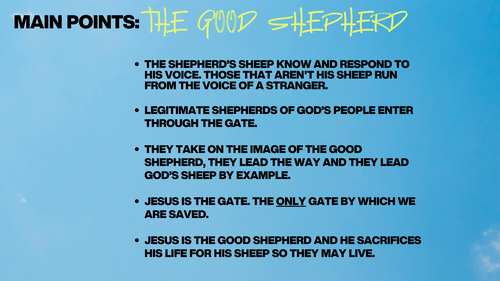
- Today we'll be reading out of John chapter 10. This is where Jesus discusses the metaphor of The Good Shepherd.
- The use of shepherding and sheep as metaphor is common throughout all of scripture.
- Perhaps one of the most famous examples comes from Psalms 23
- 1 The Lord is my shepherd, I shall not want.
2 He makes me lie down in green pastures;
He leads me beside quiet waters.
3 He restores my soul;
He guides me in the paths of righteousness
For His name’s sake. 4 Even though I walk through the valley of the shadow of death,
I fear no evil, for You are with me;
- 1 The Lord is my shepherd, I shall not want.
- And so on. So God continually compares himself to shepherd throughout scripture. What does it mean for me as a New Testament believer? And what does Jesus mean when he uses this metaphor in John 10?
- We're gonna figure that out today. But first some context before we jump into John 10. Because John 10 is a direct continuation from what was happening in chapter 9.
- Chapters and verses were not present in the scriptures originally. They were added later to help with memorization and to help readers have a reference point to find scriptures more easily. And they're very effective in doing those things.
- But with that in mind we need to pay close attention at times because a new chapter doesn't always mean a new idea or a break in the story as is often the case in contemporary books with chapters.
- So you can pick up a bible open to a random chapter, start reading and come away with a completely wrong understanding of what's being said if you’re not careful. Proper context is key to understanding scripture.
- So let's do a quick read over of what happened in John 9 so we can properly examine John 10 in context.
Legitimate Shepherds
- So who is Jesus still talking to going into John 10? The Pharisees. And in what we’re about to read Jesus is addressing their spiritual blindness. Now with the proper context of what all led to this let's see what Jesus tells the Pharisees.
- John 10:1-6
- 1 “I tell you the truth, anyone who sneaks over the wall of a sheepfold, rather than going through the gate, must surely be a thief and a robber! 2 But the one who enters through the gate is the shepherd of the sheep. 3 The gatekeeper opens the gate for him, and the sheep recognize his voice and come to him. He calls his own sheep by name and leads them out. 4 After he has gathered his own flock, he walks ahead of them, and they follow him because they know his voice. 5 They won’t follow a stranger; they will run from him because they don’t know his voice.”
6 Those who heard Jesus use this illustration didn’t understand what he meant
- 1 “I tell you the truth, anyone who sneaks over the wall of a sheepfold, rather than going through the gate, must surely be a thief and a robber! 2 But the one who enters through the gate is the shepherd of the sheep. 3 The gatekeeper opens the gate for him, and the sheep recognize his voice and come to him. He calls his own sheep by name and leads them out. 4 After he has gathered his own flock, he walks ahead of them, and they follow him because they know his voice. 5 They won’t follow a stranger; they will run from him because they don’t know his voice.”
- Now you may not see the specifics yet but what Jesus just said here is a direct rebuke to the Pharisees leadership, and what just took place with this beggar.
- But in order to understand that first we need to understand a little about sheep & sheepfolds.
- Sheep are completely incapable of caring for themselves. They are utterly dependent on their shepherd for their survival. Their wool never stops growing so without a shepherd to shear them their own sweater will kill them. Sheep are not bright creatures. If not attended to they get themselves lost and are prone to fear and panic. And in their panicked state particularly in the middle east sheep are known to wander off cliffs, killing them. Sheep have absolutely zero defensive mechanisms. Without a shepherd to protect them from predators they will be eaten, which kills them.
- Without a shepherd, without someone leading them, caring for them and tending to them they will die.
- So knowing this, to protect their sheep at night a shepherd would place his sheep in a sheepfold. A sheepfold is like a holding pen or enclosure for the sheep. A sheepfold only had one entrance protected by the shepherd or a gatekeeper. Shepherds would often find a cave to use or build one out of rocks if out in the wilderness. If they were in a town there was often a communal sheepfold shared by different shepherds with different flocks.
- Now if there are multiple flocks in one sheepfold how did Shepherds know which sheep were theirs? Well the shepherds knew their sheep and the sheep knew the voice or call of their shepherd. And when the morning came and the gate was opened for the shepherd he would call out and only his sheep would come out of the fold following his voice because sheep don't follow a voice they don't recognize.
- In these verses I know we don't see it now but it'll be confirmed later in the passage. The sheepfold represents the nation of Israel and the sheep are the Jewish people.
- Throughout scripture the leaders of Israel were described as shepherds. People like Moses, Joshua and the leading priests were the shepherds of Israel. This is also how the Pharisees viewed themselves as they were the leaders of Israel.
- And understanding all that, look back at the passage again. Jesus is rebuking the Pharisees for their poor shepherding of Israel. In fact Jesus goes farther and tells them that they are illegitimate shepherds, that true shepherds are known by the gatekeeper, the gate is opened for them and the sheep recognise their shepherds voice. Jesus tells them they have entered the fold through another way.
- Jesus is telling the Pharisees that they have snuck into the sheepfold and they are thieves and robbers seeking to harm and profit off of the sheep of Israel.
All of this imagery that Jesus is using comes out of Ezekiel 34 and Jeremiah 23. - Look at Ezekiel 34:1-4
- Then this message came to me from the Lord: 2 “Son of man, prophesy against the shepherds, the leaders of Israel. Give them this message from the Sovereign Lord: What sorrow awaits you shepherds who feed yourselves instead of your flocks. Shouldn’t shepherds feed their sheep? 3 You drink the milk, wear the wool, and butcher the best animals, but you let your flocks starve. 4 You have not taken care of the weak. You have not tended the sick or bound up the injured. You have not gone looking for those who have wandered away and are lost. Instead, you have ruled them with harshness and cruelty.
- Isn't this exactly what we just saw in John 9? How the Pharisees treated the beggar, as well as those in the synagogue who dared to recognize their Messiah.
- So what is God going to do about it? That is answered in Jeremiah 23.
- 1 “What sorrow awaits the leaders of my people—the shepherds of my sheep—for they have destroyed and scattered the very ones they were expected to care for,” says the Lord.
2 Therefore, this is what the Lord, the God of Israel, says to these shepherds: “Instead of caring for my flock and leading them to safety, you have deserted them and driven them to destruction. Now I will pour out judgment on you for the evil you have done to them. 3 But I will gather together the remnant of my flock from the countries where I have driven them. I will bring them back to their own sheepfold, and they will be fruitful and increase in number. 4 Then I will appoint responsible shepherds who will care for them, and they will never be afraid again. Not a single one will be lost or missing. I, the Lord, have spoken!
“For the time is coming,” says the Lord, “when I will raise up a righteous descendant from King David’s line. He will be a King who rules with wisdom. He will do what is just and right throughout the land. 6 And this will be his name: ‘The Lord Is Our Righteousness.’ In that day Judah will be saved, and Israel will live in safety.
- 1 “What sorrow awaits the leaders of my people—the shepherds of my sheep—for they have destroyed and scattered the very ones they were expected to care for,” says the Lord.
- God is going to raise up a righteous descendant from King David’s line. He will gather together his flock and bring them back into their own sheepfold. And he will anoint responsible shepherds to care for them.
- Jesus is the shepherd! He enters through the gate. He is recognised by the gatekeeper and his sheep recognise his voice and come to him. He gathers his flock, he walks ahead of them and leads them out because they follow his voice.
- Israel is a communal sheepfold, multiple flocks. When the shepherd came he called out. For those like the Pharisees it was the voice of a stranger. But the sheep that belonged to the shepherd recognized his voice.
- Fun fact, the greek word used to describe the Pharisees throwing the beggar out of the synagogue is the same word used in verse 4 describing the shepherd gathering his sheep.
- Sheep run from strangers and thieves but they follow the voice of their shepherd. When that beggar was being thrown out what was actually happening was Jesus was gathering his sheep.
- Now the imagery of the shepherd in this passage though ultimately talking about Jesus it also extends beyond that. Remember back to Jeremiah 23 “then I will appoint responsible shepherds who will care for them”. Shepherds, plural because this is also talking about legitimate shepherds placed over God’s sheep.
- It's a blueprint for proper leadership among God’s people. The pastors of God’s people. Did you know pastor comes from a Latin word meaning shepherd. So what are legitimate pastors of God’s people like?
- They come through the gate. We’ll talk more about that in a moment. But they come through the gate. And their voice is recognized by the sheep just like their master's voice. And here is the most important part. Just like the master shepherd who walks ahead of his sheep and leads them, legitimate pastors and shepherds take on the image of their master and lead from the front.
- Legitimate shepherds' lives mirror what they preach, they lead from the front, their lives serve as an example for the sheep that follow them.
- That's what it looks like to truly be a shepherd of God’s people.
- Now the Pharisees didn't understand what Jesus was saying. They didn't understand because they weren't his sheep. But Jesus continues and explains and expands on what he just told them.
The Only Gate
- John 10:7-10
- 7 So he explained it to them: “I tell you the truth, I am the gate for the sheep. 8 All who came before me were thieves and robbers. But the true sheep did not listen to them. 9 Yes, I am the gate. Those who come in through me will be saved. They will come and go freely and will find good pastures. 10 The thief’s purpose is to steal and kill and destroy. My purpose is to give them a rich and satisfying life.
- Here Jesus makes one of his 7 I AM statements in the book of John and declares himself to be the gate of the sheepfold.
- And again Jesus is giving a rebuke to the Pharisees but the focus has shifted. Before the focus was on the shepherds, it was a comparison between the Pharisees and legitimate shepherds of God’s people. But now the focus is on the gate and who dictates access to the sheepfold.
- Before the point was to rebuke their poor leadership and compare it to a legitimate shepherd. Now Jesus is focusing on rebuking their pride, their misguided sense of authority as mediators between God and people. And he is comparing that to his authority as the true mediator between God and people.
- And with this shift in focus, the context of the sheep and sheepfold also shifts.
- Jesus is no longer talking about a communal sheepfold. Where he calls out his own from among the fold. The sheepfold Jesus talks about here is a fold holding a single flock.
- The sheepfold represents God or relationship with God and the sheep are those who have entered into that relationship, receiving salvation.
- In chapter 9, the parents of the beggar were afraid to give the Pharisees an honest answer about their son, why? Because the Pharisees had threatened to throw anyone out of the synagogue who acknowledged Jesus as Messiah.
- They were afraid because to the Jews the synagogue was the fold. It was the meeting place of God’s people, it's where they worshiped. To be removed from the synagogue was to be excommunicated, isolated from your own community but even greater than that it was seen as being separated from God.
- And at the end of the chapter we see the Pharisees throw the beggar out of the fold. In their eyes they had just removed him from access to God.
- And Jesus rebukes them and declares that he is the only gate.
- That all those who came before. Those that believed themselves to be the mediator. Those that taught in order to get to God you have to go through me.
- They were all thieves and robbers. The false prophets, false teachers, the Pharisees.
- But the true sheep didn't listen to them.
- Jesus tells them that those who come into the fold through him will be saved.
- He reiterates this in John 14:6 to his disciples.
- 6 Jesus told him, “I am the way, the truth, and the life. No one can come to the Father except through me.
- There is no way to the Father except through Jesus! There is no way to salvation except through Jesus!
- Let it correct any lies we may believe that there are multiple paths to God.
- If our unbelieving friends & family's faith is not placed firmly and solely in the Jesus Christ of the Bible they have not entered into salvation.
- If they died today they would be separated from God for eternity, cast out into darkness.
- How will they know unless someone tells them? So go tell them! Jesus knows his sheep and his sheep will respond to his call. Not always immediately as many of us know. But eventually they will respond to his voice.
- Jesus is the only gate. And those that enter into him will come and go freely and find good pasture. Now this isn't talking about entering salvation and exiting salvation.
- This phrase of coming and going is a common idiom found throughout the bible and it's talking about everyday life. As you come and go through everyday life, everyday activities. Those that enter through the gate, they will be free! They will come and go throughout their days and the shepherd will lead them to good pastures. Jesus will be with you all day throughout your day.
- And there is such a cool parallel to what Jesus is saying here in the book of Numbers that blew my mind when I read it. It's a prayer Moses prayed in Numbers 27:15-18 (NIV)
- 15 Moses said to the Lord, 16 “May the Lord, the God who gives breath to all living things, appoint someone over this community 17 to go out and come in before them, one who will lead them out and bring them in, so the Lord’s people will not be like sheep without a shepherd.”
18 So the Lord said to Moses, “Take Joshua son of Nun, a man in whom is the spirit of leadership, and lay your hand on him.
- 15 Moses said to the Lord, 16 “May the Lord, the God who gives breath to all living things, appoint someone over this community 17 to go out and come in before them, one who will lead them out and bring them in, so the Lord’s people will not be like sheep without a shepherd.”
- Did you guys know Jesus is a Greek name? It is a Greek name for the Hebrew name Joshua. This book was put to page by man but it was not written by man.
- It never ceases to blow me away the interwovenness of scripture. The intricacies.
- Jesus continued and said, The thief’s purpose is to steal and kill and destroy. My purpose is to give them a rich and satisfying life.
- Many of you have probably heard this scripture used in reference to Satan. He comes to kill, steal and destroy. And though that's undoubtedly true, the proper context of this verse is talking about the Pharisees, false prophets and false teachers. Their purpose is to kill, steal and destroy God’s sheep. And there is certainly no shortage of these sorts around today so be wise in who you give your ear to.
- But Jesus’ purpose is to give his sheep a rich and satisfying life! I don't like how the NLT words this. I think with the way it's worded there's the danger of giving too much focus to our lives here and now. Other translations word it: I have come that they may have life and life abundantly.
- What Jesus is saying is that he came to give his sheep life. And life that is plentiful and extensive. Jesus isn’t just talking about now, he’s talking about eternal life. Jesus’ focus was always on eternity rather than the here and now. His purpose was to die so that we can live and receive eternal life.
- Jesus continues with this in verse 11
The Good Shepherd
- John 10:11-21
- 11 “I am the good shepherd. The good shepherd sacrifices his life for the sheep.12 A hired hand will run when he sees a wolf coming. He will abandon the sheep because they don’t belong to him and he isn’t their shepherd. And so the wolf attacks them and scatters the flock.13 The hired hand runs away because he’s working only for the money and doesn’t really care about the sheep.
14 “I am the good shepherd; I know my own sheep, and they know me, 15 just as my Father knows me and I know the Father. So I sacrifice my life for the sheep.16 I have other sheep, too, that are not in this sheepfold. I must bring them also. They will listen to my voice, and there will be one flock with one shepherd.
17 “The Father loves me because I sacrifice my life so I may take it back again. 18 No one can take my life from me. I sacrifice it voluntarily. For I have the authority to lay it down when I want to and also to take it up again. For this is what my Father has commanded.”
19 When he said these things, the people were again divided in their opinions about him. 20 Some said, “He’s demon possessed and out of his mind. Why listen to a man like that?” 21 Others said, “This doesn’t sound like a man possessed by a demon! Can a demon open the eyes of the blind?”
- 11 “I am the good shepherd. The good shepherd sacrifices his life for the sheep.12 A hired hand will run when he sees a wolf coming. He will abandon the sheep because they don’t belong to him and he isn’t their shepherd. And so the wolf attacks them and scatters the flock.13 The hired hand runs away because he’s working only for the money and doesn’t really care about the sheep.
- The next I AM statement in this passage. Jesus declares that he is the Good Shepherd!
- That the Good Shepherd sacrifices his life for the sheep.
- And here he again rebukes the Pharisees but this time instead of likening them to thieves and robbers Jesus likens them to a hired hand.
- In no way is this a promotion for the Pharisees. Here Jesus is revealing and rebuking the hearts and motives of the Pharisees. All the while making a statement about himself.
- Because who hires the hired hands? The Shepherd! Jesus is saying to the Pharisees I have placed you in the position you are in. I put you there to watch over and tend to my sheep but all you care about is money.
- Whenever trouble comes and my flock is attacked you abandon my sheep and my sheep have been scattered.
- Jesus tells them his sheep do not belong to them, that they are not the true shepherd and they care nothing for his sheep.
- Jesus then reiterates that as the Shepherd he knows his sheep and his sheep know him. And he likens his relationship with the sheep to his relationship with the Father.
- Jesus and the Father are one, likewise Jesus and his sheep are one. We’re the body of Christ, scripture says. Jesus obeys the will of his father and we obey the will of Jesus.
- And then Jesus says that he has other sheep too. Sheep not in this sheepfold. But he will bring them too and they will listen to his voice and be joined and become one flock with one shepherd.
- He’s talking about us! If you're not Jewish. Gentiles, non Jews. Those among the gentiles that are his sheep, they will listen to his voice and join his flock too.
- From there Jesus touches more on his sacrifice for his sheep. He tells the Pharisees that there is no one who can take my life from me. Jesus knows that they will try but ultimately it is only Jesus who has the authority to give up his life and he does so willingly so that his sheep might live.
- And it is Jesus alone who has the authority to take his life up again. Talking about the resurrection. All of this has been commanded by the Father.
- Jesus in this rebuke of the Pharisees also gives the gospel. And just like when we share the Gospel what happened?
- There was division. Because to some it's an unfamiliar voice. But his sheep recognised his voice.
Posted in Sermon Notes
Recent
AppQuestions // The Itchy Ear #1
October 19th, 2026
Outline // The Itchy Ear #1
October 18th, 2026
AppQuestions // The Battle for Control #4: The Price
October 12th, 2026
Outline // The Battle for Control #4: The Price
October 11th, 2026
AppQuestions // The Battle For Control #3: The Treasure(r)
October 5th, 2026
Archive
2026
January
Outline // Monuments #1: Build Where God Shows UpAppQuestions // Monuments #1: Build Where God Shows UpOutline // Monuments #2: The Lord is My BannerAppQuestions // Monuments #2: The Lord is My BannerOutline // Monuments #3: So That They Will AskAppQuestions // Monuments #3: So That They Will AskSNOW DAY STUDYAppQuestions // SNOW DAY WEEKOutline // Monuments #4: Repair the Altar
February
AppQuestions // Monuments #4: Repair the AltarPoem: "When I Asked If You Believed In God..."Outline // Monuments #5: The Man, The Monument, The ChristAppQuestions // Monuments #5: The Man, The Monument, The ChristOutline // Sunday School #1: Adam & EveAppQuestions // Sunday School #1: Adam & EveOutline // Sunday School #2: Cain & AbelAppQuestions // Sunday School #2: Cain & AbelOutline // Sunday School #3: Noah's Ark
March
AppQuestions // Sunday School #3: Noah's ArkOutline // Sunday School #4: The Tower of BabelAppQuestions // Sunday School #4: The Tower of BabelOutline // Sunday School #5: Joseph & The Coat of Many ColorsAppQuestions // Sunday School #5: Joseph & The Coat of Many ColorsOutline // Sunday School #6: A Baby In A BasketAppQuestions // Sunday School #6: A Baby In A BasketOutline // Sunday School #7: Joshua & The Battle of JerichoAppQuestions // Sunday School #7: Joshua & The Battle of Jericho
April
Outline // Sunday School #8: The Cross, The Veil, The Risen KingAppQuestions // Sunday School #8: The Cross, The Veil, The Risen KingOutline // Sunday School #9: Gideon in the WinepressAppQuestions // Sunday School #9: Gideon in the WinepressOutline // Sunday School #10: Gideon the Baal CrusherAppQuestions // Sunday School #10: Gideon the Baal CrusherOutline // Sunday School #11: David & GoliathAppQuestions // Sunday School #11: David & Goliath
May
Outline // FV's 34th BirthdayAppQuestions // FV's 34th BirthdayOutline // Guest Speaker: Seth ReichartAppQuestions // Deep Dive: Do You Want to Get Well?Outline // Sunday School #12: Samson & DelilahAppQuestions // Sunday School #12: Samson & DelilahOutline // Sunday School #13: Esther the QueenAppQuestions // Sunday School #13: Esther the QueenOutline // Sunday School #14: Daniel & The Lion's Den
June
AppQuestions // Sunday School #14: Daniel & The Lion's DenAppQuestions // Sunday School #15: Jonah & The WhaleOutline // Sunday School #16: Mary & ElizabethAppQuestions // Sunday School #16: Mary & ElizabethOutline // Sunday School #17: John the BaptistAppQuestions // Sunday School #17: John the BaptistOutline // Sunday School #18: The Tempting
July
AppQuestions // Sunday School #18: The TemptingOutline // Sunday School #19: Fishers of MenAppQuestions // Sunday School #19: Fishers of MenOutline // Sunday School #20: Feeding the 5,000AppQuestions // Sunday School #20: Feeding the 5,000Outline // Sunday School #21: The Water WalkerAppQuestions // Sunday School #21: The Water WalkerOutline // Sunday School #22: The Beatitudes
August
AppQuestions // Deep Dive: Tim BennettOutline // Deep Dive: Tim BennettOutline // Sunday School #23: Perform A MiracleAppQuestions // Sunday School #23: Perform a MiracleOutline // Sunday School #24: The Wedding at CanaAppQuestions // Sunday School #24: The Wedding at CanaOutline // Sunday School #25: The Good ShepherdOutline // Sunday School #25: The Good ShepherdOutline // Sunday School #26: ZaccheusAppQuestions // Sunday School #26: Zaccheus
September
Outline // Sunday School #27: Would You Like To Get Well?AppQuestions // Sunday School #27: Would you like to get well?Outline // Sunday School #28: LazarusAppQuestions // Sunday School #28: LazarusOutline // The Battle for Control #1: The ThiefAppQuestions // The Battle for Control #1: The ThiefOutline // The Battle for Control #2: The Right Time To ObeyAppQuestions // The Battle for Control #2: The Right Time To Obey
2025
October
Outline // Come Follow Me #1: TestimoniesAppQuestions // Come Follow Me #1: TestimoniesOutline // Come Follow Me #2: The Cage of ResponsibilityAppQuestions // Come Follow Me #2: The Cage of ResponsibilityOutline // Come Follow Me #3: The Cage of RoutineAppQuestions // Come Follow Me #3Outline // Come Follow Me #4: The Cage of AssumptionsAppQuestions // Come Follow Me #4: The Cage of AssumptionsOutline // Come Follow Me #5: The Cage of GuiltAppQuestions // Come Follow Me #5: The Cage of GuiltOutline // Come Follow Me #6: The Cage of VictimhoodAppQuestions // Come Follow Me #6: The Cage of VictimhoodOutline //. Come Follow Me #7: The Cage of FearAppQuestions // Come Follow Me #7: The Cage of FearOutline // Come Follow Me #8: Get Your Own OilAppQuestions // Come Follow Me #8: Get Your Own OilOutline // What Lies Ahead #1: Servanthood & Humility