Comment

F2410: Peter

Character Study - Peter

Elements:

  • Name & scriptures

  • Summary of their story (Background, when and where they lived, family, meaning of their name)

  • What they are known for

  • Strength & weaknesses (Characteristics)

  • Victories & challenges

  • How they point us to christ

  • Lessons we can learn from them

  • Questions you have from the story

Nov 6 - Peter
Jesus affectionately gives his closest friend, Simon, the nickname "Rocky," though the Greek form of the name is "Peter." Peter is a fisherman until Jesus calls him to be a disciple or "a fisher of men." Peter soon becomes the "rock" on which Jesus would build his church, even giving him the keys to the kingdom of heaven. Therefore, according to Catholic doctrine, Peter is the first Pope, the vicar (or substitute) of Christ.

But even Jesus's closest confidant betrays him, as on the eve of the crucifixion, Peter denies knowing Jesus three times. Following Jesus's death, Peter spreads Christianity abroad, and while in Rome, tradition holds that in 64 C.E., Nero has Peter crucified upside-down — a request Peter makes so as not to denigrate Jesus's death. His tomb is now encased within St. Peter's Basilica.

Next Character Study: Paul

Important Parts about Paul:

  • Acts 7:58

  • Acts 9:1-22

  • Acts 15:36-16:10

  • Acts 28:11-31

  • Romans 8:28-30

  • 2 Corinthians 5:10

  • 2 Corinthians 12:1-10

  • Galatians 1:13-21

  • Galatians 2:1-10

  • Philippians 3:4-6

  • 2 Timothy 4:6-8

Comment

Comment

F249: Jesus

Character Study - Jesus

Elements:

  • Name & scriptures

  • Summary of their story (Background, when and where they lived, family, meaning of their name)

  • What they are known for

  • Strength & weaknesses (Characteristics)

  • Victories & challenges

  • How they point us to christ

  • Lessons we can learn from them

  • Questions you have from the story

Oct 30 - Jesus

The New Testament's story of Jesus is as fascinating as it is inspiring. Born and raised in the "backwaters" of the Roman Empire, Jesus begins a religious movement that eventually overtakes the Empire. According to the New Testament, Jesus is the Messiah ("anointed one," Greek "Christos"), the promised deliverer of Israel, whose death on the cross brings deliverance from sin, and whose eventual return to earth will bring deliverance from oppression by ushering in God's kingdom. Jesus's message of caring for the downtrodden, extending kindness to strangers, and loving one's enemies is still unrivaled for its profound insight and penetrating simplicity.

  • Who is Jesus to you?

    • What does the word “Messiah” mean?

  • How would you describe Jesus to a non-believer?

    • If you were to ask the average person where you work, “Who is Jesus Christ?” what would they say?

Next Character Study: Peter

Important Parts about Peter:

  • Matthew 14:28-31

  • Matthew 16:13-19

  • Mark 8:27-33

  • Luke 22:55-61

  • John 6:66-69

  • John 21:15-19

  • Acts 4:8-21

Comment

Comment

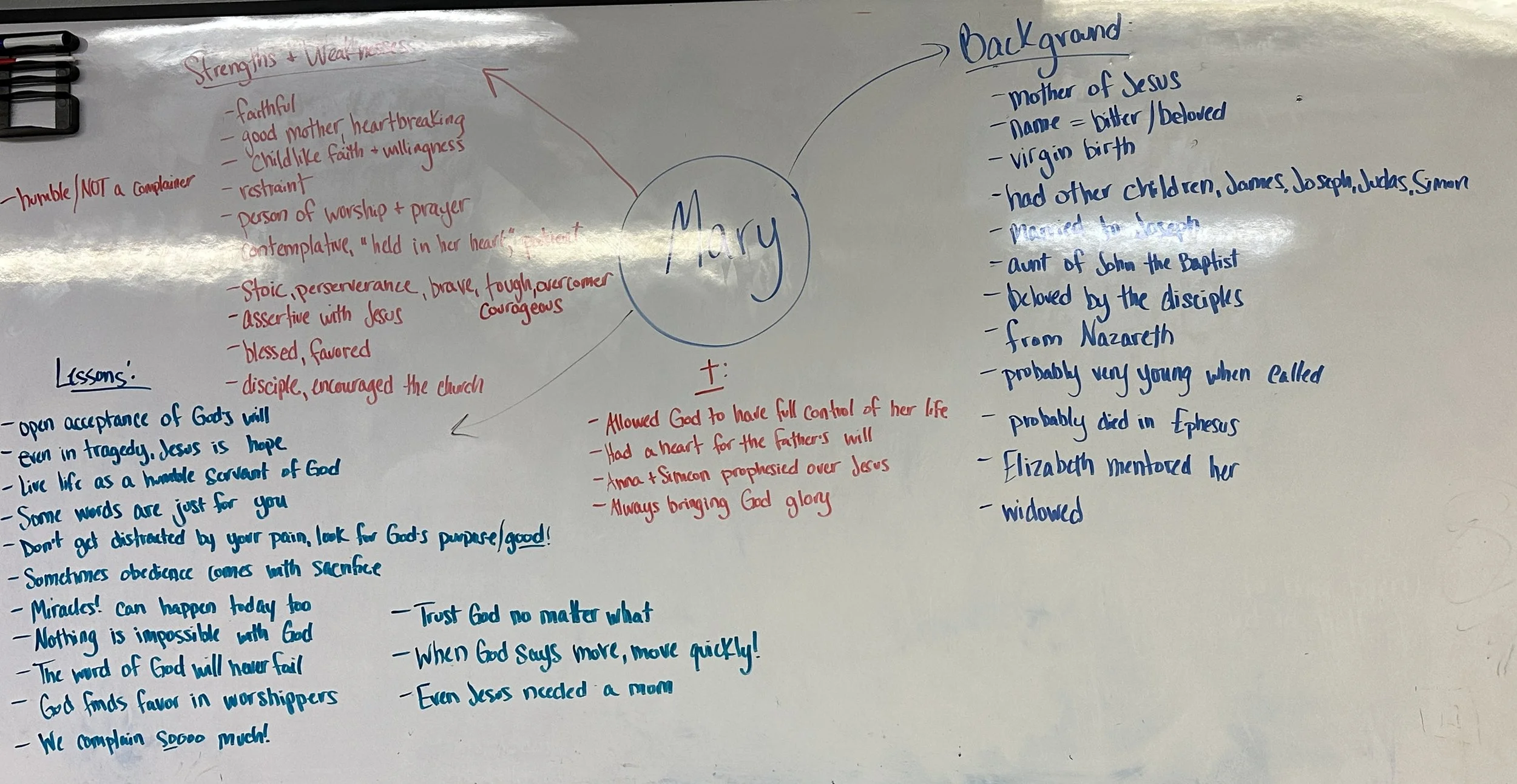
F248: Mary

Character Study - Mary

Elements:

  • Name & scriptures

  • Summary of their story (Background, when and where they lived, family, meaning of their name)

  • What they are known for

  • Strength & weaknesses (Characteristics)

  • Victories & challenges

  • How they point us to christ

  • Lessons we can learn from them

  • Questions you have from the story

Oct 23 - Mary

Being Jesus's mom, as you might imagine, is bound to put you in the theological limelight, and Mary holds this office with dignity and grace.
Betrothed to Joseph at a young age, Mary becomes pregnant under mysterious circumstances. Two of the four gospels claim that God is the father of her baby, but because of the silence of the other two gospels, as well as the lack of this being mentioned by Peter and Paul, it seems the doctrine of Jesus's virgin birth wasn't emphasized in the early Church — though it certainly did dominate later. The picture of Mary in the gospels is one of a concerned and loving mother who doesn't fully understand her son at times, but supports him to the end, even painfully witnessing his execution at the foot of the cross.

Much of what Christians believe about Mary arose after her lifetime and highlights theological differences between Catholics and Protestants. For Catholics, Mary maintained her virginity throughout her life. Thus, Jesus's "brothers" and "sisters" were either children fathered by Joseph from previous marriages, or cousins. But for most Protestant groups, these were just what the text says: full siblings. Also in death, Catholics believe that Mary's assumption to heaven involved not only her soul, but her body as well. For all Christians, Mary becomes venerated more than any other woman in the Bible.

Next Character Study: Jesus

Important Parts about Jesus: (split up groups for reading)

  • Matthew: Maggie, Theresa, Brittany

  • Mark: Chelsea, Greta, Candace

  • Luke: Lynsey, Denyse, Chaulin, Amanda, Vicki,

  • John: Becky, Sara, Elizabeth, Michelle,

Comment

Comment

F247: Isaiah

Character Study - Isaiah

Elements:

  • Name & scriptures

  • Summary of their story (Background, when and where they lived, family, meaning of their name)

  • What they are known for

  • Strength & weaknesses (Characteristics)

  • Victories & challenges

  • How they point us to christ

  • Lessons we can learn from them

  • Questions you have from the story

Oct 16 - Isaiah

Isaiah is one of the most influential prophets in the Hebrew Bible. During his career, Isaiah advises several kings of Judah, helping them to avoid being destroyed by the mighty Assyrian Empire (around 700 B.C.E.).

Beyond Isaiah's political influence, he is a masterful poet, with many of his prophecies inspiring hope for eventual peace and righteousness on earth. Several of these prophecies were later understood by Christians to be predictions of Jesus, including the birth of Immanuel; the coming of the Prince of Peace, as quoted in Handel's Messiah; and the suffering of God's "Servant" for the sins of His people.

Next Character Study: Mary

Important Parts about Mary:

  • Matthew 1-2

  • Matthew 12:46-50/Mark 3:31

  • Luke 1-2

  • John 2

  • John 19:25-27

  • Acts 1:14

Comment

Comment

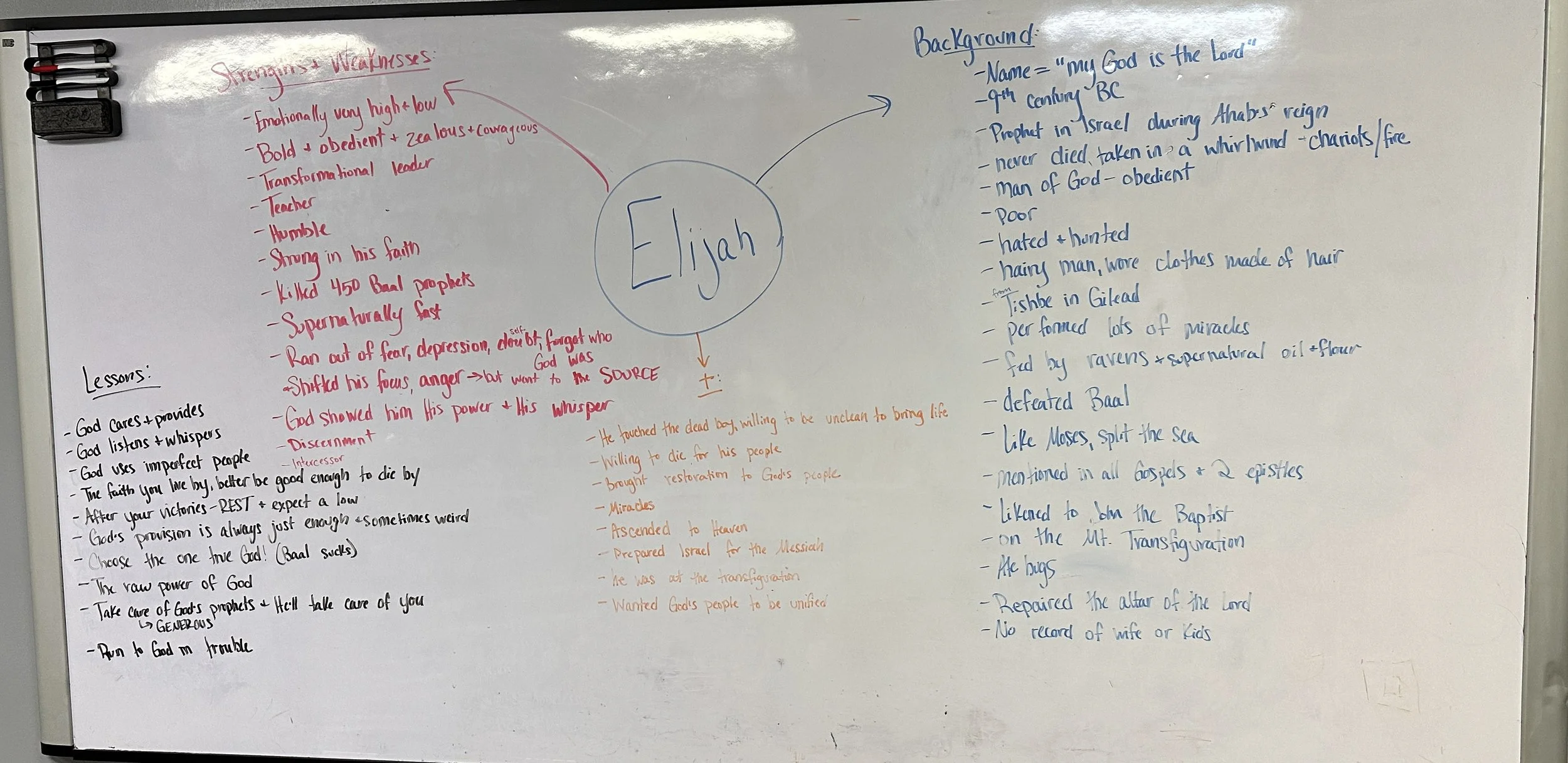
F246: Elijah

Character Study - Elijah

Elements:

  • Name & scriptures

  • Summary of their story (Background, when and where they lived, family, meaning of their name)

  • What they are known for

  • Strength & weaknesses (Characteristics)

  • Victories & challenges

  • How they point us to christ

  • Lessons we can learn from them

  • Questions you have from the story

Oct 9 - Elijah

Elijah is one of Israel's greatest prophets, as well as God's heavyweight champ in an epic bout against a deity named Baal (the Canaanite storm god). In order to prove to the Israelites that God is the only true God, Elijah gathers the prophets of Baal at Mount Carmel, where for the main event each deity is given a pile of wood with a bull on it. The god who can produce fire and consume the sacrifice wins. Baal goes first, and for half the day his prophets dance, shout, sing, and even cut themselves in order to convince their god to answer Elijah's challenge. When their efforts fail, Elijah prays to God, who immediately sends fire down from the sky and consumes the sacrifice. The Israelites rededicate themselves to God, and they kill the prophets who deceived them into worshiping Baal.

Later, near the Jordan River, a fiery horse-drawn chariot descends from the sky and takes Elijah to heaven, but not before he appoints a successor named Elisha. Elijah's atypical departure influenced later biblical prophets, who predicted that Elijah would return as a precursor to the coming of the Messiah. Because of these prophecies, Jews invite Elijah every Passover to usher in the age of the Messiah, and the New Testament writers associate John the Baptist, the forerunner of Jesus's ministry, with Elijah.

Next Character Study: Isaiah (the book of Isaiah)

Important Parts about Isaiah:

  • Isaiah 1, 6-9, 20, 30, 37-39

Comment

Comment

F245: David

Character Study - David

Elements:

  • Name & scriptures

  • Summary of their story (Background, when and where they lived, family, meaning of their name)

  • What they are known for

  • Strength & weaknesses (Characteristics)

  • Victories & challenges

  • How they point us to christ

  • Lessons we can learn from them

  • Questions you have from the story

Oct 2 - David

David is Israel's second and greatest king. As a boy, David courageously defeats a mighty enemy warrior named Goliath with only a sling and a stone. As a man, David conquers all Israel's enemies and begins a dynasty that would rule Jerusalem for nearly 500 years. But not all the news surrounding David is good. David perpetrates one of the Bible's most heinous crimes: He commits adultery with a woman named Bathsheba, who's the wife of one of David's most loyal soldiers, Uriah. Then, to cover up the crime, David has Uriah killed. In David's favor, when the prophet Samuel confronts David with his sin, David repents. Moreover, in God's favor, God forgives David for his sin, but not without punishing David for his crime.

Beyond David's royal exploits (and indiscretions), he's credited with writing many of ancient Israel's worship songs, which you can read in the Book of Psalms.

Next Character Study: Elijah

Important Parts about Elijah:

  • 1 Kings 17-19

  • 2 Kings 1-2

Comment

Comment

F244: Moses

Character Study - Moses

Elements:

  • Background:

    • Name & scriptures

    • Summary of their story (when and where they lived, family, meaning of their name), What they are known for

  • Strength & weaknesses (Characteristics)

    • Victories & challenges

  • Lessons we can learn from them

  • How they point us to christ

  • Questions you have from the story

Sept 25 - Moses
The Hebrew Bible describes Moses as the greatest prophet who ever lived, and for good reason. Moses is born during hard times for ancient Israel. Israelites are enslaved in Egypt, and their growing population so alarms the Egyptians that the Egyptian king orders all newborn Israelite males drowned in the Nile River.

Moses's mother saves her son's life by placing him in the Nile in a reed basket, where he is soon discovered by Pharaoh's daughter, who ironically raises Moses in the royal palace. After he's grown, Moses must flee Egypt for killing an Egyptian who was beating an Israelite slave.

Eventually, God appears to Moses in a burning bush and tells him that he must return to Egypt to deliver the Israelites from their slavery. With God's help, Moses succeeds in his mission, bringing the Israelites to Mount Sinai, where God first appeared to Moses. At Mount Sinai, God gives Moses the Law, including the Ten Commandments. Moses eventually leads the Israelites to the edge of their Promised Land (ancient Canaan; later Israel), where he dies at the ripe old age of 120.

Next Character Study: David

Full Story: 1 Samuel 16-31, all of 2 Samuel, 1 Kings 1-2, about half of the Psalms,

Important Parts: (David is mentioned in the Bible 983 times. 😳)

  • Shepherd – 1 Samuel 16-17

  • General – 1 Samuel 18-27

  • King – 2 Samuel 2-5, 2 Samuel 11-13, 1 Kings 1

  • Psalms: Psalm 51-61

Comment

Comment

F243: Abraham

Character Study - Abraham

Elements:

  • Name & scriptures

  • Summary of their story (Background, when and where they lived, family, meaning of their name)

  • What they are known for

  • Strength & weaknesses (Characteristics)

  • Victories & challenges

  • How they point us to christ

  • Lessons we can learn from them

  • Questions you have from the story

Sept 18 - Abraham

The Bible is filled with stories about people disobeying God. One notable exception is Abraham, a man who, though not perfect, obeys God's command to leave his homeland in Mesopotamia and venture to an unknown Promised Land (ancient Canaan; later Israel). God promises Abraham that his descendants will become a great nation, through which all the people of the earth will be blessed.

The tales of Abraham and his wife, Sarah, are a roller coaster of dramatic events that repeatedly jeopardize God's promise. Ironically, the biggest threat to God's promise is when God Himself commands Abraham to sacrifice his son, Isaac. Abraham sets out to do just as God orders, but right before Abraham delivers the fatal blow to his own child, God stops the sacrifice. As a reward for Abraham's faith, God fulfills His promise to make Abraham's descendants a great nation, as Isaac's son, Jacob, eventually has 12 sons, whose descendants become the nation of Israel.

Today, three of the world's major religions — Judaism, Christianity, and Islam — trace their roots to Abraham.

Next Character Study: Moses

Full Story: Entire book of Exodus, Numbers, and Deuteronomy

Important Parts about Moses:

  • Early Life: Exodus 1-2

  • Calling: Exodus 3-4

  • Pharoah & the Plagues of Egypt: Exodus 5-12

  • Escape through Red Sea: Exodus 13-15

  • Mt. Sinai: Exodus 17-19

  • The Golden Calf: Exodus 32

  • Moses Strikes The Rock: Numbers 20

  • Death: Deuteronomy 34

Comment

Comment

F242: Noah

Character Study - Noah

Elements:

  • Name & scriptures

  • Summary of their story (Background, when and where they lived, family, meaning of their name)

  • What they are known for

  • Strength & weaknesses (Characteristics)

  • Victories & challenges

  • How they point us to christ

  • Lessons we can learn from them

  • Questions you have from the story

Noah is most famous for building an ark — a giant three-decked wooden box in which he, his family, and a whole bunch of animals ride out a massive flood that God sends to destroy humankind for its disobedience. God chooses Noah and his family to survive the deluge because Noah is "the most righteous in his generation." Noah is important not only because his ark decorates most nurseries in North America but also because, according to the Bible, if Noah hadn't been righteous, none of us would be here right now.

Scripture: Genesis 5:32-10:1

Next Character Study: Abraham

Read: Genesis 11:27-20

Comment

Comment

F241: Adam & Eve

Character Study

Elements:

  • Name & scriptures

  • Summary of their story (Background, when and where they lived, family, meaning of their name)

  • What they are known for

  • Strength & weaknesses (Characteristics)

  • Victories & challenges

  • How they point us to christ

  • Lessons we can learn from them

  • Questions you have from the story

Videos on how to do this:

  1. https://www.tiktok.com/@dididesir/video/7382615481791876395?_r=1&_t=8pFWGcNPZyl

  2. https://www.tiktok.com/@gathering.honey/video/7296561755923205418

Next Character Study: Noah

Read: Genesis 5:32-10:1

Comment

Comment

S249:

What do we believe about God’s character. Where do we put our immediate trust when a situation arises out of the blue and is beyond our control?

A deep dive of Psalm 91 shows the depths of Gods mercy and lovingkindness. It shows:

Who He is.

What he does

His goal for humanity

His unmerited favor

And what is required of us.

The psalmist shows Gods strength and might in the names used in just the first verse:

Lord -(Yahweh)-sacred name of GOD

Significance of the Name:

God reveals himself as “Yahweh” during significant moments, such as entering a covenant with Abraham. This name symbolizes God’s faithfulness and unchanging nature.

When God reveals himself as “Yahweh” to Moses, it serves as a reminder that he keeps his promises and can be trusted.

In summary, “Yahweh” represents God’s personal name, closely tied to his being and his redemptive acts throughout history. It signifies his faithfulness and unchanging nature, assuring us that we can rely on him

Elyon- (The most High)

Shaddai- Mighty, unconquerable, Mountain

This psalm isn’t telling us we wont have troubles, it doesn’t say we will be worry free, the ultimate goal of the psalm is to affirm again and again the constant nature of our GOD and how we move in this world standing firm as a spiritual battles wages all around us.

-Read Daily until we meet next, see what else you can extract from this psalm.

-Memorize and remind yourself next time you a hard situation arises

-If you find yourself falling into a woe is me attitude, remember the Psalm

-Find other verses that remind you of God’s loving kindness to you.

Comment

Comment

S248: What Can I Get Away With?

Structure of this semester:

  1. Big Picture Instruction: 16 Fundamental Truths

  2. Bible Study: The Wrong Questions!

  3. Bible Questions

Big Picture: AG 16 Fundamental Truths

14. THE MILLENNIAL REIGN OF CHRIST

The second coming of Christ includes the rapture of the saints, which is our blessed hope, followed by the visible return of Christ with His saints to reign on earth for one thousand years.

This millennial reign will bring the salvation of national Israel,

and the establishment of universal peace.

15. THE FINAL JUDGMENT

There will be a final judgment in which the wicked dead will be raised and judged according to their works. Whosoever is not found written in the Book of Life, together with the devil and his angels, the beast and the false prophet, will be consigned to the everlasting punishment in the lake which burneth with fire and brimstone, which is the second death.

(TOP)

16. THE NEW HEAVENS AND THE NEW EARTH

"We, according to His promise, look for new heavens and a new earth wherein dwelleth righteousness."

Bible Study: 1 Kings 13

What Can I Get Away With?

1 Kings 13:1-34

When you're in obedience, God is your defender
Doubting Gods Word can be dangerous
No room for the blame game

  • Come up with one question to bring to B&B next month!

  • Challenge: Find another WRONG question in the Bible!

Comment

Comment

S247: What Can I Get Away With?

Structure of this semester:

  1. Big Picture Instruction: 16 Fundamental Truths

  2. Bible Study: The Wrong Questions!

  3. Bible Questions


Big Picture: AG 16 Fundamental Truths

13. THE BLESSED HOPE

The resurrection of those who have fallen asleep in Christ and their translation together with those who are alive and remain unto the coming of the Lord is the imminent and blessed hope of the church.


  • Come up with one question to bring to B&B next month!

  • Read 1 Kings 13

  • Do something with someone new from this group (or church in general). Go out to lunch, get coffee, have a play date, something outside of church! Make a new friend!

Comment

Comment

S246: A Sanctified Mouth and a Consecrated Life

A Consecrated Mouth

Luke 11: 1-4

"Teach us to pray"

How many of us have an issue with what comes out of our mouths?

What does consecrate mean? 

Consecrate: to make or declare sacred, to set apart, to devote to a particular purpose in a very sincere manner

You don't own yourself. Once we become redeemed, you are no longer your own. 

He wants us to be filled with Him, so He can do what He needs to do on the Earth.

You are here as a spiritual diplomat. 

What does a diplomat do? You need to be able to speak on behalf of our Father. Therefore, He needs us to be set apart. 

We let anything come out of our mouths - you hurt yourself and your cause with unclean lips.

We give the enemy access to us by our mouths. 

Limit your intake - what comes across the airwaves enters and whatever enters will come out of your mouth. 

Don't let the enemy have control of your mouth. Make it a point: I will bless the Lord at all times. 

Declare and Speak it. Get into The Word so that The Word comes out of your mouth.

Feel the feeling, but choose the behavior. 

People get caught up in their feelings, but, your feelings will catch up with your decisions. 

Speak what God says - keep speaking it. I don't care what the situation looks like, keep speaking it. 

Words have created power. 

Flip the trajectory of words:

Example: someone says "good luck", flip that to "The Favor of God"

You can't have a consecrated mouth when you have junk coming in - monitor what is coming in. Especially parents: monitor what is coming in for your kids, airwaves become hypnotic for children. 

You are what you "eat" (what's coming in) / the stuff you are listening to. Recognize it and ask God to help you change the pattern. 

Be prayed up. Don't have a slow reaction time.

You're gonna play in the game as hard as you practice. 

You are on the front line, regardless of your job. Don't let the enemy have a crack. 

1. Ask yourself: on a scale of 0 to 10, how consecrated is your mouth?

2. How can you consecrate your ears and eyes by 10% over the next month? (Example: Not watching trashy reality TV)


Comment

Comment

S245: ASK the question, even if it's the wrong question

Structure of this semester:

  1. Big Picture Instruction: 16 Fundamental Truths

  2. Bible Study: The Wrong Questions!

  3. Bible Questions


Big Picture: AG 16 Fundamental Truths

12. DIVINE HEALING

Divine healing is an integral part of the gospel. Deliverance from sickness is provided for in the atonement, and is the privilege of all believers.


Bible Study: Luke 11

The Question Unasked

Luke 11:1-13

This story isnt about laziness or selfishness
This story isnt about annoyance
This story is about shameless persistence

  • Come up with one question to bring to B&B next week!

  • Read Luke 11.

  • Research a “sanctified mouth” and a “consecrated life”. What does it look like to be set apart?

Comment

Comment

S244: Walking in love and forgiveness

What does it mean to really love others?

”Don’t just pretend to love others. Really love them. Hate what is wrong. Hold tightly to what is good.“ Romans 12:9 NLT

”Let love be without hypocrisy. Abhor what is evil. Cling to what is good.“ Romans 12:9 NKJV

”Be sincere in your love for others. Hate everything that is evil and hold tight to everything that is good.“ Romans 12:9 CEV

”Don’t copy the behavior and customs of this world, but let God transform you into a new person by changing the way you think. Then you will learn to know God’s will for you, which is good and pleasing and perfect.“ Romans 12:2 NLT

Take aways from Joyce

Forgiveness is such a big part of walking in love. We cannot truly love without forgiveness.

Forgiveness is not:

    1.    a feeling

    2.    Pretending you were not hurt

    3.    Condoning what was done

    4.    Trusting the offender

    5.    Relieving the person of responsibility

Effects of unforgiveness

Steps to forgiving

    1.    Pray for yourself to have a proper attitude

    2.    Ask God to make you willing to forgive

    3.    Choose to forgive and tell God (out loud) that here and now you are choosing to forgive.

    4.    Ask God to forgive your offender

    5.    Ask God to bless them.

Know that it takes faith to forgive

You may or may not feel any different at all. Draw that line that you will never cross over again, knowing that feelings do not dictate the decision, but your spirit will be free.

Matthew 18:21-35

Ephesians 4:31&32

1) Do the Live People Bible study together with your B&B sisters.

2) Journal about your progress of loving others and walking in forgiveness

3) Take the forgiveness challenge. Pray each morning and declare by God’s help that you predetermine to forgive anyone who offends you. Don’t worry if you mess up, just ask God’s forgiveness and keep on forgiving.

Comment

Comment

S243: What Can You Do For Me?

Structure of this semester:

  1. Big Picture Instruction: 16 Fundamental Truths

  2. Bible Study: The Wrong Questions!

  3. Bible Questions


Big Picture: AG 16 Fundamental Truths

11. THE MINISTRY

A divinely called and scripturally ordained ministry has been provided by our Lord for the fourfold purpose of leading the Church in:

Evangelization of the world.

Worship of God.

Building a body of saints being perfected in the image of His Son.

Meeting human need with ministries of love and compassion.


Bible Study: John 6

What Can You Do For Me?

John 6:25-54; John 6:60:71

Jesus doesnt always make it easy
Jesus will push through your walls
Jesus asks for total commitment

  • Come up with one question to bring to B&B next month!

  • Read Luke 11.

  • Do something with someone new from this group (or church in general). Go out to lunch, get coffee, have a play date, something outside of church! Make a new friend!


The All Too Important Difference Between a Guest Speaker and a Pastor

By Larry Osborne

Like many pastors, I was told that I needed to preach memorable sermons. At least that was the emphasis in every preaching course I took and every communications book I’ve ever read. 

But the longer I’ve been in local church ministry, the more I think that their emphasis on producing highly memorable sermons was misguided. 

It confused the role of a guest speaker with that of a local church pastor. Or to put it another way, it confuses the difference between a Thanksgiving feast and Tuesday night’s dinner. 

Thanksgiving dinner is always amazing. It’s supposed to be memorable, filled with special treats. Something to look forward to and reflect upon. But a steady diet of Thanksgiving dinners would hardly remain special. Not to mention, making everyone fat.

On the other hand, my mom’s Tuesday night dinners were seldom special or memorable. But a steady diet of her healthy meals is what produced healthy kids. 

Here’s some things I’ve learned about the difference between guest speaking and speaking to a local congregation along the way. 

1. As a guest speaker, I’ve got just one chance to make a difference.

So I always do my best to be as memorable as possible. I want everything to be laser focused. I need to discipline myself to pick a main point and drive it home with the best hooks, illustrations, and stories that I’ve got. It’s a preacher’s version of serving a Thanksgiving feast.

2. As a pastor preaching to a congregation on a regular basis I have time on my side

Rather than a one-and-done blast from a water cannon, I have the luxury of dripping in key spiritual truths over and over again. In fact, I’ve learned to avoid preaching a sermon series on the most important things I want our people to know and do. Dripping those things in over and over is far more life changing. 

3. Trying to turn every sermon into a memorable masterpiece is a idealistic recipe for frustration and discouragement.

Looking back, those who told me that good pastors strive to make every sermon a memorable Thanksgiving dinner were seldom people who actually preached on a regular basis. 

Truth be told, most of us can’t remember what we taught three weeks ago. And when you consider that we spent hours studying the text, organizing our thoughts, and fine-tuning our delivery, it’s no surprise that those who heard it once can’t remember our careful alliterations, main points, or much else. But that doesn’t mean God isn’t at work. For the majority of our listeners, a good sermon is a lot like Mom’s Tuesday night dinner.  It provides them with spiritual nutrients they need to continue to grow in their faith and to stay healthy. 

Sure, there are always a few who are spiritually ripe for a big-time change. That’s what the Holy Spirit does. But to expect that to be the norm for most of our hearers is a recipe for frustration and discouragement. 

4. The worst part of trying to turn every message into a banquet is that too many people end up remembering only the funny story, powerful illustration, or the creative props we used. 

And when you ask them how it impacted their life, they have no idea what the text or spiritual application was.  

Now none of this is to say that a pastor’s weekly sermon should be bland, boring, or come across like a foul-tasting (but highly nutritional) liver dinner. Far from it.

It’s simply to say, relax. Teach the text. Explain what it means on Monday. Keep it real. 

Don’t bore people. To make the Bible boring is a crime. But don’t try to turn everything into a banquet feast. Preaching that results in genuine and lasting life change and discipleship is very different than preaching that produces a reputation for creativity and the applause that comes with it.

By Larry Osborne

Comment

Comment

S242: What if they don't believe me?

Wrong Questions we found this week:

  • Luke 10:40

  • Mark 4:38

  • Exodus 4:10-12

Structure of this semester:

  1. Big Picture Instruction: 16 Fundamental Truths

  2. Bible Study: The Wrong Questions!

  3. Bible Questions


Big Picture: AG 16 Fundamental Truths

10. THE CHURCH AND ITS MISSION pt 2

The Assemblies of God exists expressly to give continuing emphasis to this reason for being in the New Testament apostolic pattern by teaching and encouraging believers to be baptized in the Holy Spirit. This experience:

  1. Enables them to evangelize in the power of the Spirit with accompanying supernatural signs.

  2. Adds a necessary dimension to worshipful relationship with God.

  3. Enables them to respond to the full working of the Holy Spirit in expression of fruit and gifts and ministries as in New Testament times for the edifying of the body of Christ and care for the poor and needy of the world.


Bible Study: Exodus 3:4-4:17

What If They Wont Believe Me?

Mistake #1: Not recognizing the authority of God
Mistake #2: Thinking it's all about you
Mistake #3: Forgetting who you're talking to
Mistake #4: Letting fear paralyze you. Even when you're asking God the wrong question, you're asking the RIGHT person!

  • Come up with one question to bring to B&B next month!

  • Read John 6.

  • Find a wrong question.

Comment

Comment

S241: When does it get better for ME?

Structure of this semester:

  1. Big Picture Instruction: continue the 16 Fundamental Truths

  2. Bible Study: The Wrong Questions!

  3. Bible Questions

    1. Rules: Must have a verse attached.


Big Picture: AG 16 Fundamental Truths

10. THE CHURCH AND ITS MISSION pt 1

The Church is the Body of Christ, the habitation of God through the Spirit, with divine appointments for the fulfillment of her great commission. Each believer, born of the Spirit, is an integral part of the General Assembly and Church of the Firstborn, which are written in heaven.

Since God’s purpose concerning man is to seek and to save that which is lost, to be worshipped by man, to build a body of believers in the image of His Son, and to demonstrate His love and compassion for all the world, the priority reason for being of the Assemblies of God as part of the Church is:

  1. To be an agency of God for evangelizing the world.

  2. To be a corporate body in which man may worship God.

  3. To be a channel of God’s purpose to build a body of saints being perfected in the image of His Son.

  4. To be a people who demonstrate God’s love and compassion for all the world.


Bible Study: Acts 1

When Does It Get Better For Me?

Acts 1:6; Acts 1:7-11

What we need to hear, not what we want to hear
Get to work
Go back down the mountain
They needed closure
They needed a commissioning
They needed to get to work
They needed a helper

  • Come up with one question to bring to B&B next month!

  • Read Exodus 3:4-4:17

  • Challenge: Find another WRONG question in the Bible!

Comment

Comment

W248: Sanctification

Structure of this semester:

  1. Big Picture Instruction: 16 Fundamental Truths

  2. Bible Questions

  3. Bible Study: Book of James


Big Picture: AG 16 Fundamental Truths

9. SANCTIFICATION

Sanctification is an act of separation from that which is evil, and of dedication unto God.

The Scriptures teach a life of "holiness without which no man shall see the Lord."

By the power of the Holy Spirit we are able to obey the command: "Be ye holy, for I am holy."

Sanctification is realized in the believer by recognizing his identification with Christ in His death and resurrection, and by the faith reckoning daily upon the fact of that union, and by offering every faculty continually to the dominion of the Holy Spirit.


James 4

1 What is causing the quarrels and fights among you? Don’t they come from the evil desires at war within you? You want what you don’t have, so you scheme and kill to get it. You are jealous of what others have, but you can’t get it, so you fight and wage war to take it away from them. Yet you don’t have what you want because you don’t ask God for it. And even when you ask, you don’t get it because your motives are all wrong—you want only what will give you pleasure.

You adulterers![a] Don’t you realize that friendship with the world makes you an enemy of God? I say it again: If you want to be a friend of the world, you make yourself an enemy of God. Do you think the Scriptures have no meaning? They say that God is passionate that the spirit he has placed within us should be faithful to him.[b] And he gives grace generously. As the Scriptures say,

“God opposes the proud
    but gives grace to the humble.”[c]

So humble yourselves before God. Resist the devil, and he will flee from you. Come close to God, and God will come close to you. Wash your hands, you sinners; purify your hearts, for your loyalty is divided between God and the world. Let there be tears for what you have done. Let there be sorrow and deep grief. Let there be sadness instead of laughter, and gloom instead of joy. 10 Humble yourselves before the Lord, and he will lift you up in honor.

Warning against Judging Others

11 Don’t speak evil against each other, dear brothers and sisters.[d] If you criticize and judge each other, then you are criticizing and judging God’s law. But your job is to obey the law, not to judge whether it applies to you. 12 God alone, who gave the law, is the Judge. He alone has the power to save or to destroy. So what right do you have to judge your neighbor?

Warning about Self-Confidence

13 Look here, you who say, “Today or tomorrow we are going to a certain town and will stay there a year. We will do business there and make a profit.” 14 How do you know what your life will be like tomorrow? Your life is like the morning fog—it’s here a little while, then it’s gone. 15 What you ought to say is, “If the Lord wants us to, we will live and do this or that.” 16 Otherwise you are boasting about your own pretentious plans, and all such boasting is evil.

17 Remember, it is sin to know what you ought to do and then not do it.

  • Come up with one question to bring to B&B next month!

  • Read James 5.

  • Do something with someone new from this group (or church in general). Go out to lunch, get coffee, have a play date, something outside of church! Make a new friend!

Comment